
Apex Trader Funding is a futures prop firm: you pay a one-time fee for a 30-day evaluation, and if you hit the profit target without touching the drawdown you get a simulated funded account (Apex calls it a Performance Account, or PA) that pays real money on approved payouts. Since March 1, 2026 Apex’s standard products follow a new rulebook with two paths, End-of-Day (EOD) drawdown and Intraday trailing drawdown; accounts on the old program are called “Legacy” (sold before that date and, at the time of writing, again in a limited-time promotion) and are covered at the end.
This article is the rulebook in one place, in plain English, with the numbers per account size and the arithmetic that decides whether an account ever pays you back. Everything below is taken from Apex’s own help center and product pages on the date in the box above, and we re-check it every four weeks.
- Four sizes (25K, 50K, 100K, 150K), two drawdown models, one-time fee, 30 days of access, no resets and no minimum trading days: you can pass in a single day.
- Evaluation: reach the target ($1,500 → $9,000) without ever touching the max drawdown ($1,000 → $4,000). EOD evaluations also carry a fixed daily loss limit (DLL); Intraday evaluations don’t (both funded accounts do).
- Funded (PA): payouts up to weekly after 5 qualifying days, each with a minimum profit ($100–$350 depending on size and path), a 50% consistency rule, a lifetime safety net (drawdown + $100), a $500 minimum and a cap of 6 payouts per account, after which the PA is closed.
- Split: 100% of approved payouts, with per-payout maximums ($1,000 on a 25K, up to $5,000 by the sixth payout on a 150K).
- Extra costs: a one-time PA activation fee ($89–$159) unless you buy the “No Activation Fee” version of the evaluation, priced separately; no refunds on anything.
- Non-negotiables: no bots or automation, no hedging of any kind (in one account or across accounts), no VPNs or cloud servers to mask your location, nothing held through the 4:59 PM ET close.
Apex plans and prices
Every plan is the same account traded under one of two drawdown models, and every evaluation comes in two versions: “Standard”, which charges a one-time activation fee when you pass, and “No Activation Fee”, which activates for $0. Apex’s checkout shows a list price and a much lower price “with coupon code” on every product (it did on the verification date; how long such codes last is not stated); both are reported here as displayed, because the gap is the single biggest factor in what an Apex account really costs.
| Account | Profit target | Max drawdown | Daily loss limit (EOD eval only) | Max contracts (eval) | Access |
|---|---|---|---|---|---|
| 25K | $1,500 | $1,000 | $500 | 4 minis / 40 micros | 30 days |
| 50K | $3,000 | $2,000 | $1,000 | 6 / 60 | 30 days |
| 100K | $6,000 | $3,000 | $1,500 | 8 / 80 | 30 days |
| 150K | $9,000 | $4,000 | $2,000 | 12 / 120 | 30 days |
Targets, drawdowns and contract limits are identical on the Intraday and EOD paths; only the EOD evaluation has a daily loss limit. Micro contracts count one tenth of a mini.
| Account | Intraday Standard list / with code | EOD Standard list / with code | Intraday No-fee list / with code | EOD No-fee list / with code | Activation fee on Standard Intraday / EOD |
|---|---|---|---|---|---|
| 25K | $167 / $16.70 | $490 / $49 | $690 / $69 | $1,090 / $109 | $89 / $109 |
| 50K | $249 / $24.90 | $590 / $59 | $490 / $49 | $1,190 / $119 | $99 / $129 |
| 100K | $790 / $79 | $1,190 / $119 | $590 / $59 | $1,590 / $159 | $129 / $139 |
| 150K | $1,190 / $119 | $2,190 / $219 | $1,890 / $189 | $2,490 / $249 | $149 / $159 |
One-time prices in USD, exactly as Apex’s product selector displayed them on the verification date; the “with code” figure is the price Apex itself shows next to the list price, while the selector shows no coupon price for the activation fee. “No-fee” is short for Apex’s “No Activation Fee” version. The Intraday No-fee ladder is not monotonic on Apex’s site (a 25K costs more than a 50K or a 100K): check the selector before buying. Five-packs of identical evaluations are sold at a discount and share one 30-day clock from the purchase date; the No Activation Fee five-pack is not offered for the 100K and 150K EOD.
Level 1 market data is included. Depth-of-market and extra data feeds are bought from the platform vendor (Rithmic, Tradovate or WealthCharts) and are your cost. Platforms are chosen at checkout; the drawdown model is fixed at purchase and cannot be changed afterward.
Apex evaluation rules: one day to pass, no resets
There are only two things to do: reach the profit target and never let the balance touch the drawdown threshold. There is no minimum number of trading days (Apex advertises “one day to pass”), no consistency rule and no scaling during the evaluation, and the full contract limit is available from the first trade. Orders above the contract limit are rejected by the platform and do not count as a violation.
- 30 calendar days of access from purchase, weekends included. The evaluation expires at 6:00 PM ET on day 30 with no extension; an unfinished balance does not carry over, and there is nothing to cancel because nothing rebills.
- No resets. Touch the drawdown and the evaluation is permanently failed; to try again you buy a new one. (Resets exist only on Legacy evaluations.)
- EOD path: the drawdown threshold is recalculated once a day at 4:59:59 PM ET and enforced in real time during the next session. A fixed daily loss limit (table above) closes all your positions for the day if hit: in Apex’s words, “reaching DLL pauses trading for the remainder of the session. Your account remains active.”
- Intraday path: the threshold trails your peak balance tick by tick, unrealized profit included, and never comes down; there is no daily loss limit.
- No hedging between accounts. You may not pass evaluations by taking offsetting positions across accounts; evaluations must be completed with independent, directional trading.
- When you pass, the account is reviewed at the close and marked “Passed” after 6 PM ET; the 7-day window to activate the funded account is explained below.
Apex drawdown explained: EOD vs. Intraday trailing
Both models use the same dollar amounts; what differs is when the floor moves. Take a 50K account with a $2,000 drawdown. On the EOD model the floor is set from the highest closing balance and, like the Intraday floor, never comes down: close day one at $51,000 and tomorrow’s liquidation level is $49,000, whatever happens during the session (the check still runs in real time on your balance including open P&L: touch $49,000 at any moment and the account is liquidated). On the Intraday model the floor follows the highest balance you reach at any moment: be up $1,500 on an open trade at 10:30 ET and the floor is already $49,500, even if you close the trade flat. That “unrealized peak” is the trap Apex itself warns about.
Two details matter on both paths. Liquidation happens at market: the final fill can land below the threshold, and the breach stands regardless. And the peak balance is computed from the next available bid and ask, so trading a contract that is not the front month, where the spread can be 70–100 points on NQ, can move the floor and liquidate the account instantly even while the chart looks normal.
In a Performance Account the trailing stops once the threshold reaches the starting balance + $100: on a 50K PA the floor locks at $50,100 when your peak balance (the highest closing balance, on the EOD path) reaches $52,100. Evaluations behave differently by platform: on Rithmic and WealthCharts the threshold locks when it reaches the profit-target balance ($53,000 on a 50K), while on Tradovate evaluations it trails indefinitely with the peak. Touching the threshold at any moment liquidates every position: a failed evaluation, or a permanently closed PA.
Apex Performance Account rules: scaling, inactivity, the 20-account cap
The PA is a simulated funded account of the same size and model as the evaluation you passed. The drawdown rule is the same, but three things change: contracts and the daily loss limit now scale up or down with your closing balance, the inactivity rule starts, and the 50% consistency requirement governs payouts. Note that the contract ceiling drops: a 50K evaluation allows 6 contracts, the 50K PA starts at 2 and never exceeds 4.
| 50K PA · profit range | Max contracts | Daily loss limit | Tier |
|---|---|---|---|
| $0 – $1,499 | 2 | $1,000 | Level 1 |
| $1,500 – $2,999 | 3 | $1,000 | Level 2 |
| $3,000 – $5,999 | 4 | $2,000 | Level 3 |
| $6,000 and up | 4 | $3,000 | Level 4 |
Tiers are set once a day from the closing balance and apply to the whole next session; the Level 1 floor never shrinks. Apex’s page prints the top tier as “$5,999 & Up”, overlapping the one below; its March 16 note says “exceeds $6,000”. Starting limits by size: 1 contract and a $500 daily loss limit on a 25K, 2 and $1,000 on a 50K, 3 and $1,750 on a 100K, 4 and $2,500 on a 150K. At the top tier: 2 / 4 / 6 / 10 contracts and $1,250 / $3,000 / $3,500 / $4,000 of daily loss limit.
- Inactivity: a PA must record at least 2 trading days with $50+ net profit in every rolling 30-day window. Reminders go out on day 15 and day 20; at day 30 the account is closed, payout eligibility is forfeited and nothing can be reinstated.
- Account cap: at most 20 active PAs per household, counting companies and partners and all platforms together; go over and you lose payout eligibility and risk a ban. Evaluations are unlimited. Copy trading between your own PAs is allowed in the same direction only (Apex’s older rules page bans copier software on PAs: ask support before using one).
- Positions through the close are prohibited: everything must be flat and pending orders canceled before 4:59 PM ET. A trading day runs from 6:00 PM ET to 4:59 PM ET the next day, so Sunday evening belongs to Monday’s session; that is the day that counts for qualifying days and for the daily loss limit reset. On exchange holidays with an early close, positions must be flat at the earlier time, and Apex’s Legacy rules state that half-day holidays do not count as trading days.
Apex payout rules: 5 days, $500 minimum, 6 payouts per account
Apex’s home page sells the new products with three promises: “5 Days for Payouts”, “No Payout Denials”, “No payout reviews”. The mechanics behind them are strict, and they are all checked automatically on your account page before the request button appears.
| PA size | Qualifying days | Min. profit per qualifying day (EOD / Intraday) | Safety net (never withdrawable) | Min. balance to request | Max payouts |
|---|---|---|---|---|---|
| 25K | 5 | $100 / $100 | $26,100 | $26,600 | 6 |
| 50K | 5 | $250 / $200 | $52,100 | $52,600 | 6 |
| 100K | 5 | $300 / $250 | $103,100 | $103,600 | 6 |
| 150K | 5 | $350 / $300 | $154,100 | $154,600 | 6 |
- Five qualifying days, not consecutive, each with at least the minimum net profit for your size; a $240 day on a 50K EOD counts for nothing. Apex’s payout-method page counts them from the day after your last payout request (or from the start of the account), and there is no deadline to collect them.
- 50% consistency: your best day must be less than half of the profit earned since the last approved payout (details and the formula below). Fail it and the button simply isn’t there; the account stays alive and you keep trading until the ratio works.
- Safety net for life: drawdown + $100 stays in the account on every one of the six payouts; only profit above it can be requested. The “minimum balance to request” already includes the $500 minimum payout.
- $500 minimum per request, whatever the size, and a maximum per payout that rises with the payout number. On a 50K EOD PA the caps run $1,500 · $1,500 · $2,000 · $2,500 · $2,500 · $3,000; on a 50K Intraday PA $1,500 · $2,000 · $2,500 · $2,500 · $3,000 · $3,000. On a 25K every payout is capped at $1,000; a 150K reaches $5,000 by the sixth. Profit beyond the cap stays in the account.
- Six payouts and the PA is closed, regardless of what is left in it. To continue you pass a new evaluation. That cap, more than the split, is what bounds the lifetime value of one account: a 25K PA can pay at most $6,000, a 50K at most $13,000 (EOD) or $14,500 (Intraday), a 100K $18,000 or $18,500, a 150K $20,500 or $21,500.
- 100% split on approved amounts. You can keep trading the moment you submit; trade as if the money were already gone, because a balance that falls below the minimum before approval gets the request denied automatically. On Tradovate the request is also checked in real time: the live balance must be at or above the minimum and there must be no open position at the moment you submit.
- Timing: Apex processes the request within 2 business days (“no payout reviews” means no discretionary review of your trading, not instant payment), sends within 3–4, your bank takes 3–7: most traders see the money in 5–11 business days. US traders are paid by ACH bank transfer, everyone else through Plane after linking a local bank account, and only to an account in your own name.
The Apex 50% consistency rule, with the math
No single trading day may account for 50% or more of the net profit accumulated since your last approved payout (or since the account started). Apex’s own shortcut: highest profit day ÷ 0.5 = minimum net profit you need. If your best day on a 50K PA was $1,500, Apex’s example says you need at least $3,000 of net profit since the last payout; if your best day was $600, $1,200. Aim strictly above twice your best day: at exactly 2× you sit on the 50% line, which Apex’s own wording (“less than 50%”) excludes. Because the rule uses net profit, losing days shrink the total, so a big win followed by a red week pushes the request further away, not closer: Apex's own example is a $1,000 day followed by a $200 loss, which puts the best day at 125% of the $800 net profit. After each approved payout the calculation resets and only looks at new profit. Breaking the ratio never fails the account: it only delays the payout.
The number that matters on Apex is not the split. It is how many of your trading days can clear the daily minimum without one lucky day owning half the profit.
Apex activation fee, deadlines and refunds
- 7 calendar days from the “Passed” mark to pay the activation fee, by 11:59 PM ET of the seventh day; miss it and the pass is void. Passing on day 30 of your access still gives you the full 7 days. The PA is created with the same login within 6 hours of payment.
- The activation fee is one-time, per account, non-transferable, and is not charged again while that PA stays alive. If the PA is closed for a breach, a liquidation or inactivity, you need a new passed evaluation and a new fee.
- No refunds on evaluations, activation fees, add-ons, wrong plan selections, platform or data errors, or coupon codes entered wrongly. Choosing the wrong size means keeping it or buying another.
- Evaluations, bundles and PAs are not subscriptions: nothing renews and nothing needs canceling. Only Legacy accounts rebill monthly.
What Apex prohibits: bots, hedging, VPNs, holding through the close
Apex’s prohibited-activities page is long; these are the items most relevant to a trader starting out:
- Automation of any kind: bots, algorithms and preprogrammed execution are not allowed. Apex’s words: rewards are meant “to recognize human traders”. A VPS to run one is pointless here, and a cloud server used to mask your location is itself a violation.
- Hedging and non-directional trading: no long and short at the same time on the same or correlated instruments, in one account or across accounts (short NQ and long ES counts, so does long minis and short micros), and no orders parked on both sides of the market around a news release hoping to catch the move. Normal strategies during news are fine.
- Money in your own name only: fees paid from your own card or bank account, payouts to an account in your own name, and no chargebacks or disputes in bad faith.
- VPNs, proxies and cloud servers used to mask identity or location, sharing accounts, devices or payment cards, a second user account for yourself (always banned), and extra accounts in your household while yours is under a restriction or probation.
- Trading without a stop (hard or mental), tiny targets against huge stops, using the drawdown threshold as your stop loss, and buying cheap evaluations to “blow through” in search of a windfall.
- Holding through the close and anything that exploits the simulated environment, high-frequency tactics included.
Violations range from a probation period with stricter rules to closure of all accounts and forfeiture of balances.
What an Apex account really costs before the first payout
Take the size Apex itself uses in most of its examples, a 50K EOD Standard evaluation, and assume you pass and request the maximum first payout of $1,500.
- Money out: $590 for the evaluation at list price, or $59 at the coupon price Apex displays, plus $129 to activate the PA. That is $719 at list, $188 at the displayed price, before any data add-ons.
- What the account must do: reach a balance of at least $53,600 to request $1,500 (the $52,100 safety net plus the request), with five days of $250+ profit and no day worth half the total. In other words about $3,600 of net profit on a $2,000 drawdown, after having already made $3,000 to pass the evaluation.
- Break-even: at list prices one maximum first payout returns about double the outlay; at the displayed coupon price about eight times. Every failed evaluation before that one adds its full fee to the “money out” column, which is where most traders’ real numbers diverge from the brochure (our data on what traders actually spend before a first payout).
- Standard or No Activation Fee? Because the selector shows coupon prices for evaluations but none for the activation fee, the answer flips with the price you pay. At the displayed coupon prices the No Activation Fee version is cheaper all-in on every size if you pass (50K EOD: $119 against $59 + $129 = $188; 25K Intraday: $69 against $16.70 + $89 = $105.70). A failed No Activation Fee evaluation, however, costs more than a failed Standard one on seven sizes out of eight (the 100K Intraday is the exception both ways). The more attempts you expect, the more the Standard entry price weighs: on a 50K EOD at coupon prices the No Activation Fee version comes out ahead only if you pass about one evaluation in two. At list prices the Standard version wins on seven sizes out of eight, again except the 100K Intraday, where No Activation Fee costs $590 against $790 + $129.
Without resets, the count of attempts is the number to watch: each failed evaluation is a new purchase at full price. On the verification date Apex’s public payouts list showed well over a hundred approved payouts for that day alone, almost all between $500 and $2,000, which matches the caps above.
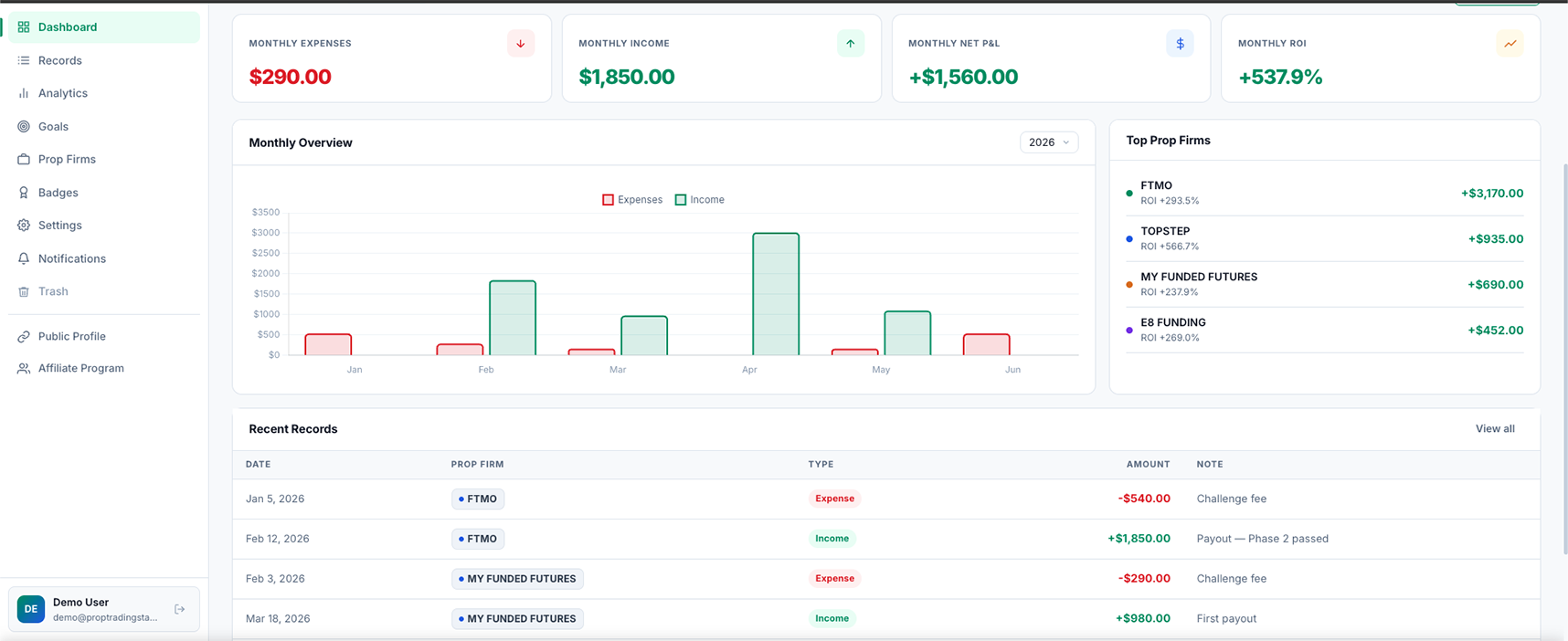
Know your real Apex number
Log each evaluation, activation fee and payout in Prop Trading Stat and see, per firm, what you have spent, what you have been paid and when Apex went into profit for you. Free, no card needed.
Track your Apex accountsApex Legacy accounts: the old program
Accounts bought before March 1, 2026 keep their original program, which Apex now calls Legacy, and the two cannot be converted into each other. Legacy evaluations are monthly subscriptions that rebill until canceled and can be reset (a failed account is even reset free when it renews). They have their own drawdowns and contract limits (a 50K: $2,500 trailing, 10 contracts), use a real-time trailing drawdown and normally need 7 trading days to pass.
Legacy PAs pay 100% of the first $25,000 per account and 90% after. Between payouts they require 8 trading days with 5 days of $50+ profit, apply a 30% consistency rule until the sixth payout, and keep the safety net only for the first three payouts. The first five payouts are capped ($1,500 on a 25K up to $3,500 on a 300K), with no cap from the sixth. They also carry the rules the new products dropped: half contracts until the trailing stop is cleared, the 30% negative-P&L (MAE) rule and the 5:1 risk-reward rule. At the time of writing Apex is selling Legacy evaluations again “for a limited time” (the promotion offers six sizes up to 300K on three platforms, monthly billing); Legacy accounts bought in this promotion after March 1, 2026 fall under the new inactivity rule. A Legacy account that lapses cannot be reinstated. Note that some of Apex’s marketing pages still carry Legacy-era promises such as “two payouts per month” or “100% of the first $25,000”; the help center pages linked in the box above are the current rulebook.
Beyond both programs sits the invitation-only Apex Live program: live accounts that start at $0 with a $3,000 end-of-day drawdown, a 90/10 split and daily payouts. Apex decides who is invited: it says it starts watching candidates after, for example, three consecutive payouts from a single PA, and its pages describe no application process. Selection has a price: all your evaluations and PAs are closed (active evaluations are refunded), and the simulated profit left in profitable PAs becomes a “Bonus Vault”, which Apex calls a tracking ledger rather than money: it may be paid as a monthly 20% bonus on live withdrawals (40% in the first month) while the live account stays active, and is forfeited if you decline the invitation or if the broker refuses you a live account. Live eligibility also depends on the broker’s country list, which excludes, among others, Canada outside Ontario, Bulgaria, Croatia, Romania, Turkey, South Africa, the Philippines, Vietnam and Nigeria: a trader from those countries gets a $3,000 payment instead of a live account, with the simulated accounts already closed.
Who the new Apex rules suit
The EOD model ignores intraday peaks but still liquidates you the moment the balance touches the floor; the Intraday model is cheap to enter and brutal on open profit. Both reward the same trader: one who can post five modest green days without a single outsized one, keep $2,100 of cushion untouched on a 50K and accept that one account pays out at most six times. Day traders with steady daily results fit; anyone who wants to hold positions overnight or run automation does not, by rule. Whatever your style, treat every evaluation fee as a cost of doing business and count them per firm, because on Apex the arithmetic, not the split, decides whether you are ahead.
Frequently asked questions
What is the maximum payout on an Apex 25K account?
$1,000 per payout on both the EOD and Intraday 25K Performance Accounts, for each of the six payouts allowed, so a 25K PA can pay at most $6,000 over its life. The minimum per request is $500 and the balance must stay above the $26,100 safety net.
How long does an Apex payout take?
Apex says it reviews the request within 2 business days, sends approved funds within 3–4 business days, and banks take another 3–7; most traders receive the money within 5–11 business days. US traders are paid by ACH, international traders through Plane.
Can I pass the Apex evaluation in one day?
Yes. The new EOD and Intraday evaluations have no minimum number of trading days: the account is marked Passed at the close of the day you reach the target, as long as the drawdown was never touched and no rule was broken.
Does Apex allow bots or automated trading?
No. Automation and algorithm usage are listed among the prohibited activities on all Apex accounts, including the live program. Copy trading between your own Performance Accounts is allowed, in the same direction only.
How does the Apex 50% consistency rule work?
Your best profitable day must be less than 50% of the net profit earned since your last approved payout (or since the account started). Apex’s shortcut: best day ÷ 0.5 = the minimum net profit you need before the payout button appears. Breaking it does not fail the account; it only delays the payout. The calculation resets after every approved payout.
How much is the Apex activation fee?
On Standard evaluations the one-time PA activation fee shown at checkout on the verification date was $89 / $99 / $129 / $149 for Intraday 25K / 50K / 100K / 150K and $109 / $129 / $139 / $159 for EOD. “No Activation Fee” evaluations are priced separately and activate for $0; at Apex’s displayed coupon prices they are the cheaper route all-in on every size if you pass and, on seven sizes out of eight, the more expensive one if you fail (the 100K Intraday is the exception). The fee must be paid within 7 calendar days of passing.
What are the Apex 50K payout rules?
On a 50K Performance Account: five qualifying days with at least $250 net profit each on the EOD path ($200 on the Intraday path), best day under 50% of the profit since the last payout, a balance of at least $52,600 to request (the $52,100 safety net plus the $500 minimum), and a maximum per payout that starts at $1,500 and rises to $3,000 by the sixth and last payout.
What happens after six Apex payouts?
The Performance Account is closed, whatever balance is left in it. To keep getting paid you pass a new evaluation and activate a new PA. Up to 20 PAs can be active at the same time per household.
How many Apex accounts can I have?
Evaluations are unlimited. Funded Performance Accounts are capped at 20 active accounts per household, counting your personal accounts, your companies, your partner and all platforms together, Legacy and new accounts included. Exceeding 20 makes you ineligible for payouts and can lead to a ban.
What can I trade on Apex?
Futures listed on CME, CBOT, NYMEX and COMEX: equity index, currency, agricultural, energy and metal futures plus their micros, Micro Bitcoin and Micro Ether, and Eurex index and bond futures on Tradovate only. Apex lists futures only; the exact symbol list depends on the platform you pick. Positions must be closed and pending orders canceled before 4:59 PM ET.
Does Apex Trader Funding have a live account?
Yes, by invitation only. The Apex Live program starts at a $0 balance with a $3,000 end-of-day drawdown, pays a 90/10 split with daily payout requests and no caps above a $3,100 safety net, and closes all your simulated evaluations and PAs when you are selected. Selection is not automatic and Apex’s pages describe no way to apply: it picks traders from their simulated track record.
Is there a daily loss limit on Apex accounts?
EOD evaluations have a fixed daily loss limit ($500 on a 25K up to $2,000 on a 150K) that closes your positions for the day; Apex’s help center says reaching it “pauses trading for the remainder of the session” and the account remains active. Intraday evaluations have none. In Performance Accounts of both types the daily loss limit exists and scales with your profit tier.
Can I reset a failed Apex evaluation?
Not on the new EOD and Intraday products: a failed evaluation is closed permanently and you buy a new one. Resets, including a free reset at renewal, exist only on Legacy evaluations bought before March 1, 2026 or during Legacy promotions.
Can I have Legacy and new Apex accounts at the same time?
Yes. The household limit of 20 active Performance Accounts counts Legacy, EOD and Intraday PAs together. Legacy accounts cannot be converted into the new types, and a passed Legacy evaluation can only become a Legacy PA.

Prop Trading StatThe tracker prop traders use to log every fee, reset and payout. We write these guides from the firms’ official rules, not from affiliate summaries. Spotted an outdated rule? Tell us.
What changed in this article
- First version, verified against Apex’s help center, product selector and news pages on October 23, 2026.
Track your Apex Trader Funding fees and payouts
Every evaluation fee, reset, activation and payout — per firm, per month — and the one number that matters: your real ROI. Free plan, no credit card.